
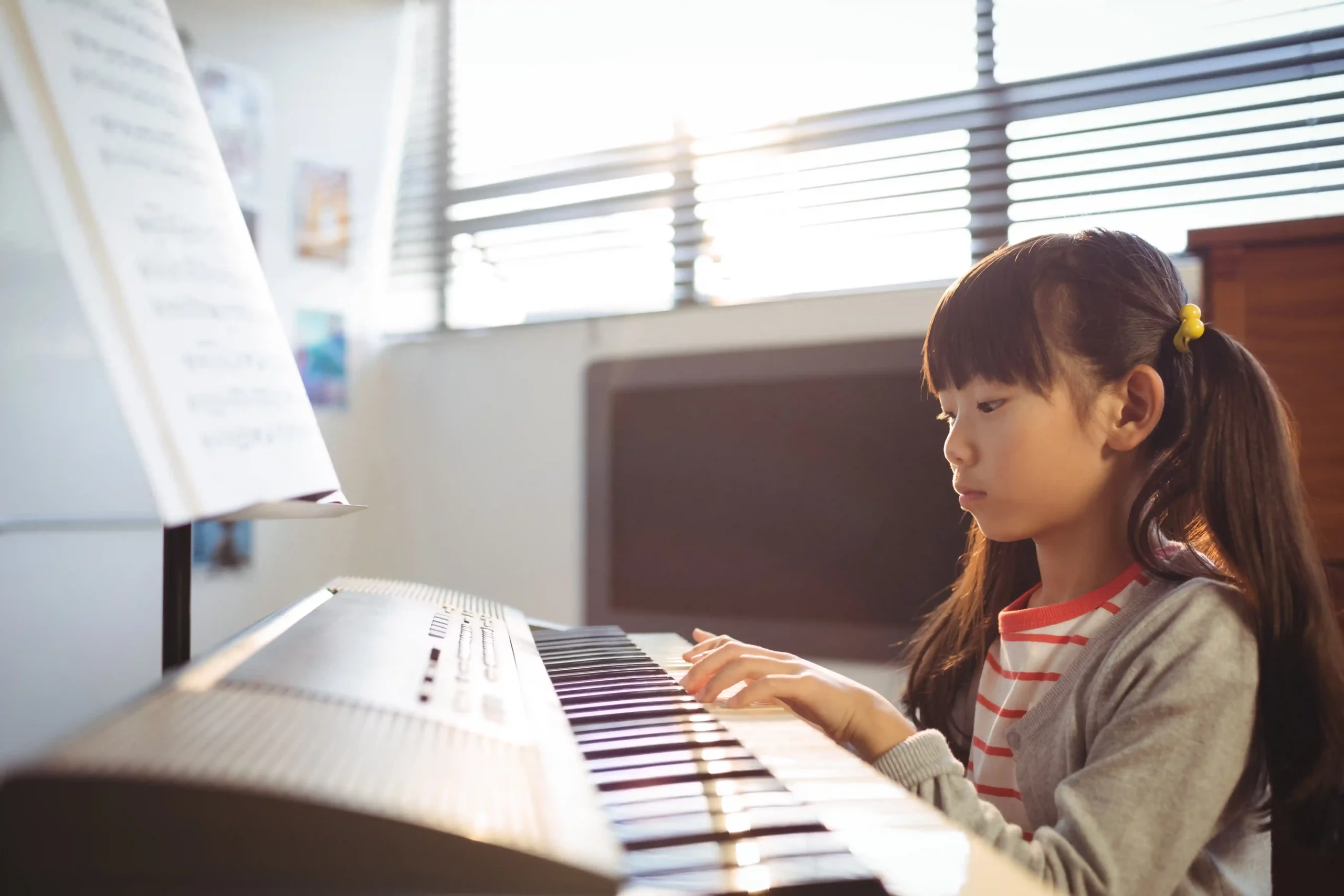

If your child keeps pressing the keys on a keyboard at a friend’s home, it is natural to wonder whether it is too early to start lessons, or already late.
Many children can start piano lessons at around age 4 or 5, so if you are wondering what age kids should start piano lessons in Singapore, that is a good place to begin. We teach piano from about that age. Every child is different, though, and readiness matters more than the birthday. If your child can pay attention to a short activity and follow simple instructions, they are likely ready for a first lesson. A later start is still wonderful, and if your child is not quite ready at 4, waiting a few months is perfectly fine.
What Is the Best Age to Start Piano Lessons for Kids?
Many children are ready for piano lessons between ages 4 and 7. At 4 or 5, many can pay attention long enough for a short activity. By 6 or 7, children usually focus for longer and follow explanations more easily. There is no single best age, and it is never too late to begin.
The research behind the “before age 7” idea is a 2013 study in the Journal of Neuroscience. It compared adult musicians who began training before age 7 with musicians who began later. Both groups had the same number of years of training. The early starters had stronger white-matter connections in the part of the brain that links the left and right motor regions, and they were more accurate on a timing task.
The researchers suggest that the years before about age 7 may be a sensitive period for musical training. That is one reason some parents prefer to start early. It is not a deadline.
The study describes a pattern in adult musicians. It does not say a child who starts at 8 or 10 cannot learn piano well, so there is no need to worry if your child starts later.
| Starting age | Main advantage | What to watch |
| 4 to 5 | More time before age 7, the age range the research highlights | Attention is still developing. Most children pay attention for 5 to 10 minutes at a time by age 5, according to the US Centers for Disease Control and Prevention. |
| 6 to 7 | Close to the age range the research highlights, and focus lasts longer | Less time before age 7 than a 4-year-old has |
| 8 and older | Longer focus and easier explanations | Starts after age 7, which does not mean a child cannot learn well |
How Can Parents Tell If a Child Is Ready for Piano Lessons?
A child is usually ready when they can pay attention to a short activity, follow a simple two-step instruction, and show interest in sounds or songs. The US Centers for Disease Control and Prevention lists paying attention for 5 to 10 minutes at a time as a milestone most children reach by age 5.
Parents do not have to decide alone, and we are glad to help. Our first piano lesson starts with a brief assessment of your child’s abilities and a talk about their goals. Then the teacher introduces basic piano techniques and concepts.
We teach piano from around age 4. For younger children, our Music Exploration course introduces rhythm and pitch through play, and is a lovely way to begin.
What Does a Child Need at Home to Start?
Your child will need an instrument to practise on between lessons. A digital keyboard is a good start for beginners if it has weighted keys, which copy the feel of a real piano. An acoustic piano is ideal, but it is not required on day one.
Our guide to the acoustic piano vs digital piano choice explains the trade-offs for Singapore homes.
Short, regular practice at home helps what is learnt in each lesson take root.
What If a Child Is Not Ready at 4 or 5?
Some children are not ready at 4 or 5, and that is normal. A child who cannot yet pay attention for 5 to 10 minutes at a time may do better starting a few months later. Waiting does not close the door, so there is no need to rush. The first lesson shows where the child stands, so the teacher can set a pace that fits.
In the meantime, a child can build the skills piano needs through everyday play. Listening to songs, clapping a steady beat, and singing along are simple, enjoyable ways to train the ear. A trial lesson a few months later gives a fresh read on readiness.
Who Teaches Piano to Young Beginners?
At Groove Music School in Singapore, piano lessons for kids are taught by A.J. and Erin. A.J. teaches in a calm, precise, and gentle way. Erin enjoys helping beginners play songs with confidence while building note reading, rhythm, and musicality. Both start from the basics, at a pace that suits your child.
Lessons build a foundation in music theory, technique, and ear training, and they leave room for creativity. Students can play pop, rock, and jazz. You are welcome to meet the rest of our teaching team on our teachers page.
We also offer music lessons in Singapore for guitar, drums, vocals, bass, and ukulele. If you are still deciding which instrument suits your child, our guide to choosing the right music lesson compares the options.
Ready to Try a First Lesson?
It is common for parents to wonder whether a child will keep their interest after the first few weeks. A trial lesson lets your child meet the teacher first, and the teacher sets the pace from there. We would be delighted to welcome your family.
One parent, Irma Felicia, says of A.J.: “AJ Is such a great, kind and patient teacher.”
Book a piano trial lesson and see how your child responds. We look forward to meeting you.
Frequently Asked Questions
Does my child need to read music before the first lesson?
No, not at all. Our teachers start from the basics. Music reading develops over time, and many accomplished players started without it.
Can my child take graded exams?
Yes. We prepare students for Trinity Rock & Pop exams. We do not currently offer ABRSM exam preparation, so check which exam board your child’s school or plans require before enrolling.
How long should a young child practise?
Keep sessions short. Since most children pay attention for 5 to 10 minutes at a time by age 5, a few short sessions each week suit a young beginner better than one long one. The teacher can suggest a routine that suits your child after the first lesson.
Can a left-handed child learn piano?
Yes. Some techniques and adaptations help left-handed pianists play comfortably, and the teacher can adjust the approach in the first lesson.


