
Here’s the honest answer: yes, adults can absolutely learn piano. The idea that you had to start as a child is one of the most persistent myths in music education, and the science simply does not support it.
You may not become a concert pianist. But you can learn to play songs you love, develop a genuinely rewarding skill, and experience benefits that go well beyond the music itself. All of that is within reach, regardless of where you are starting from.
Adults Think It's Too Late, and Why They're Wrong
The “you should have started as a child” belief is understandable. We’ve all grown up watching child prodigies and assuming early exposure is everything. But what that narrative leaves out is this: adult brains are far more capable of learning new skills than most people give them credit for.
Neuroscience research confirms that the brain retains its ability to form new connections throughout life, a property known as neuroplasticity. Music training is one of the most powerful triggers for this kind of change. Brain changes are detectable after just one weekof musical stimulation. A major review in Frontiers in Neuroscience confirmed that musical training causes structural differences in the brain, including increased grey matter and stronger neural connections, regardless of when training begins.
There is no biological cut-off for learning piano. What changes with age is the speed of building muscle memory, not the brain’s capacity to learn.
Adults Actually Have Advantages Over Children
This surprises most people, but experienced piano teachers will tell you the same thing: adults are often easier to teach than children.
Motivation is self-driven.Adults choose to learn for their own reasons, not because a parent signed them up. That internal motivation translates into more focused practice and better follow-through between lessons.
Adults grasp theory faster.Concepts like chord progressions, time signatures, and song structure that take children years to absorb often click quickly for adult learners. You have decades of listening experience and analytical thinking to draw on, even if you’ve never studied music formally.
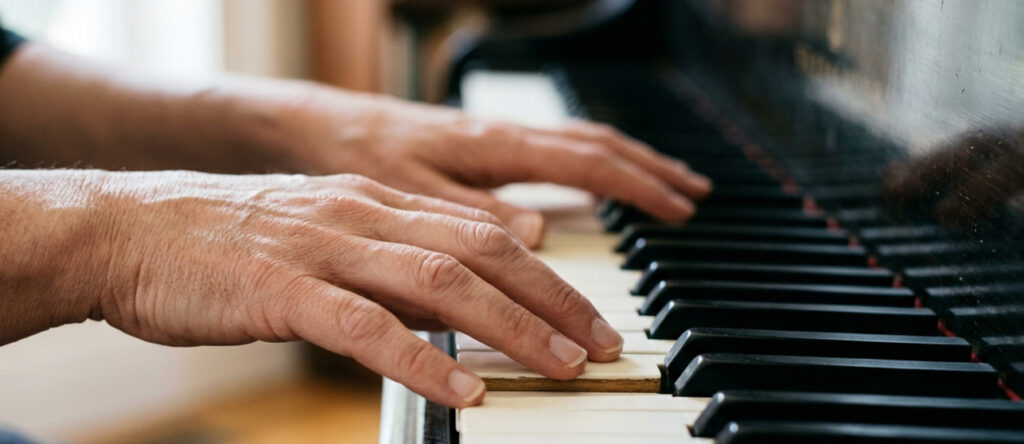
Fully grown hands are an advantage.Most children cannot comfortably span an octave until ages 10 to 12. Adult hands can manage this from the very first lesson, opening up a wider range of repertoire immediately.
Emotional depth shows in your playing.Music is about expression, and adults bring lived experience to that. The ability to connect emotionally with what you’re playing is something that genuinely can’t be taught, and adults already have it.
The Benefits of Learning Piano as an Adult in Singapore
A real outlet from work stress
Work pressure in Singapore is well-documented.61% of Singaporean employees report burnout, and adults are actively looking for ways to decompress that go beyond scrolling a phone.
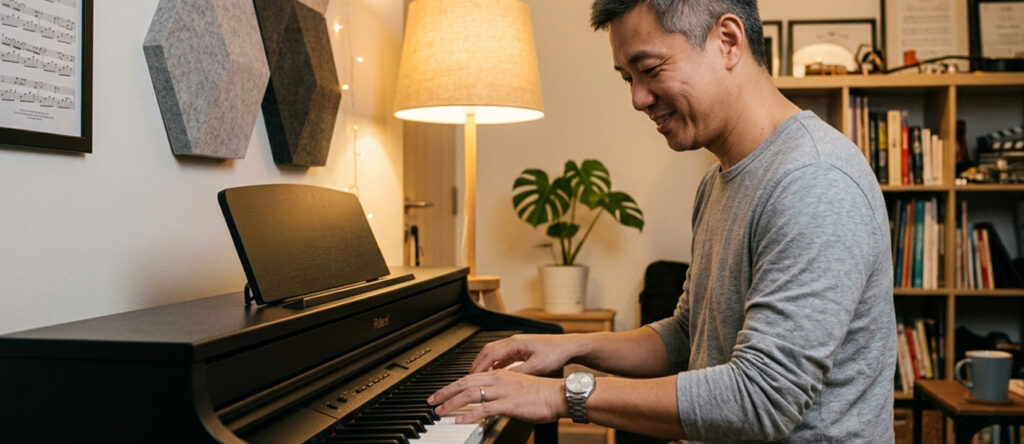
Playing piano is one of the most effective stress relievers available.Research in the International Journal of Music Educationfound that piano playing was more effective at reducing cortisol, the body’s primary stress hormone, than other creative activities including clay modelling and calligraphy. The neurochemical effect is real: music triggers dopamine and endorphin release, producing a genuine sense of calm. The focus required also means there is simply no mental bandwidth left for work worries while you are playing.
Sharper cognitive performance
Learning piano is a full-brain workout.A study in Aging & Mental Healthfound that adults aged 60 to 85 who took six months of piano lessons showed large improvements in processing speed and cognitive flexibility, gains that lasted three months after lessons ended.A study in Frontiers in Psychologyfound that just four months of piano training improved executive function and divided attention in older adults.
For Singapore professionals managing demanding schedules, those gains have everyday value: better focus, stronger working memory, and a greater ability to handle multiple tasks at once.
Long-term protection against cognitive decline
This is arguably the most compelling reason to start, particularly for adults in their 40s and beyond. Multiple independent studies have found that playing a musical instrument significantly reduces the risk of dementia.A Karolinska Institute twin studyfound musicians were 64% less likely to develop dementia than non-musicians, controlling for genetics and shared environment.
A 2022 study in Frontiers in Aging Neurosciencefound that six months of piano training in adults aged 64 to 78 stabilised white matter in a region of the brain closely associated with memory and early Alzheimer’s progression. The non-playing control group showed measurable decline over the same period.
Starting piano isn’t just picking up a hobby. It’s one of the most evidence-backed investments you can make in your brain health.
Creative expression that’s entirely your own
For many Singapore adults, work and family responsibilities leave very little room for personal pursuits. Piano offers something that belongs entirely to you, a creative outlet with no performance reviews, no deadlines, and no expectations from anyone else.
The progress is also deeply personal. Learning a piece you genuinely love, at your own pace, and developing a skill you carry for life is something many adult learners describe as unexpectedly fulfilling.
How the Right Teacher Changes Everything
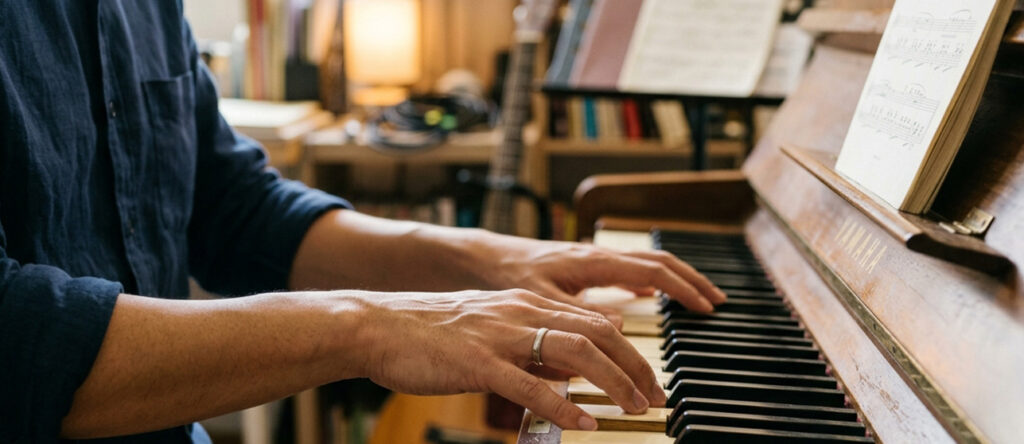
Adult learners have specific needs that not every music teacher is set up to address. A teaching approach built around children’s exam syllabuses and rigid timelines will rarely work well for an adult who is learning for personal fulfilment.
Good instruction for adults is personalised. It starts with understanding what you actually want: a particular song, a new hobby, a stress outlet, or a long-held goal finally being acted on. Then it moves at your pace, using your strengths rather than working around them.
Getting technique right from day one also prevents long-term frustration. Good posture, hand position, and finger placement established early on saves months of unlearning later. A qualified teacher catches these things in real time, something no app or tutorial can replicate.
At Groove Music School, piano lessons for adults are built around exactly this approach. Instructors take time to understand each student’s goals, lifestyle, and learning style before tailoring a programme to suit. There are no fixed milestones to hit and no pressure to perform before you’re ready.
Groove’s qualified teachers act as mentors, not just instructors. They combine science-based technique with emotional and mental alignment, helping students build genuine confidence alongside practical skill. For adult learners in particular, that wider perspective makes a meaningful difference to the experience.
Groove also welcomes students from all walks of life, from children as young as 4 to seniors,whether you’re picking up the piano for the first time at 25 or returning to music at 60. Lessons are entirely personalised to your goals, your pace, and your learning style, so you’re never pushed through a one-size-fits-all programme. With vocals, guitar, drums, ukulele, and piano all available under one roof, there’s also the option to explore other instruments or understand how piano fits into a broader musical picture, all in one place.
What to Realistically Expect: A Simple Timeline
Progress varies from person to person, but with consistent practice and good instruction, most adult beginners follow a broadly similar path.
|
Stage |
What to Expect
|
|---|---|
|
First 1 to 3 sessions |
Playing your first simple melody or chord |
|
1 to 3 months |
Playing short pieces you recognise and enjoy |
|
3 to 6 months |
Building a small repertoire and developing basic hand coordination |
|
6 to 12 months |
Playing with genuine confidence and your own developing style |
The exact pace depends on how consistently you practise and the quality of instruction you receive. Adults who show up regularly with a good teacher typically progress faster than they expected.
Ready to Find Out What You're Capable Of?
The most important step is simply the first one. You don’t need to own a piano before you begin. Starting with lessons and practising on quality instruments is the most practical approach. A few weeks will tell you more about your pace and preferences than any amount of online research.
At Groove Music School, personalised piano lessons are available for adults at all experience levels, from complete beginners to those returning to music after a long break. Visit the piano lessons page to find out more, or book a trial lesson to experience it for yourself.