
Picking your first instrument is an exciting moment, but it can also feel like a surprisingly difficult decision. Should you start with a guitar or a ukulele? How much does size matter? What about noise in an HDB flat?
These are practical questions worth thinking through, and this guide gives you a clear, honest comparison so you can choose the instrument that genuinely fits your life and goals.
At a Glance: Guitar vs Ukulele
Before diving into the details, here is a simple side-by-side overview.
|
Acoustic Guitar |
Ukulele (Soprano) |
|
|---|---|---|
|
Starting price (Singapore) |
~$59 to $350 |
~$39 to $120 |
|
Number of strings |
6 |
4 |
|
String material |
Steel or nylon |
Nylon/nylgut |
|
Fingertip soreness |
Yes (2 to 4 weeks) |
Minimal |
|
Size |
Large (96 to 104 cm) |
Compact (53 cm) |
|
Noise level |
Louder (~84 dB strumming) |
Quieter (~82 dB strumming) |
|
Learning curve |
Moderate |
Gentle |
|
Musical versatility |
Very broad |
Moderate |
|
Best suited for |
Teens, adults, long-term players |
Children, beginners, HDB households |
Size and Feel: What to Expect When You Pick One Up
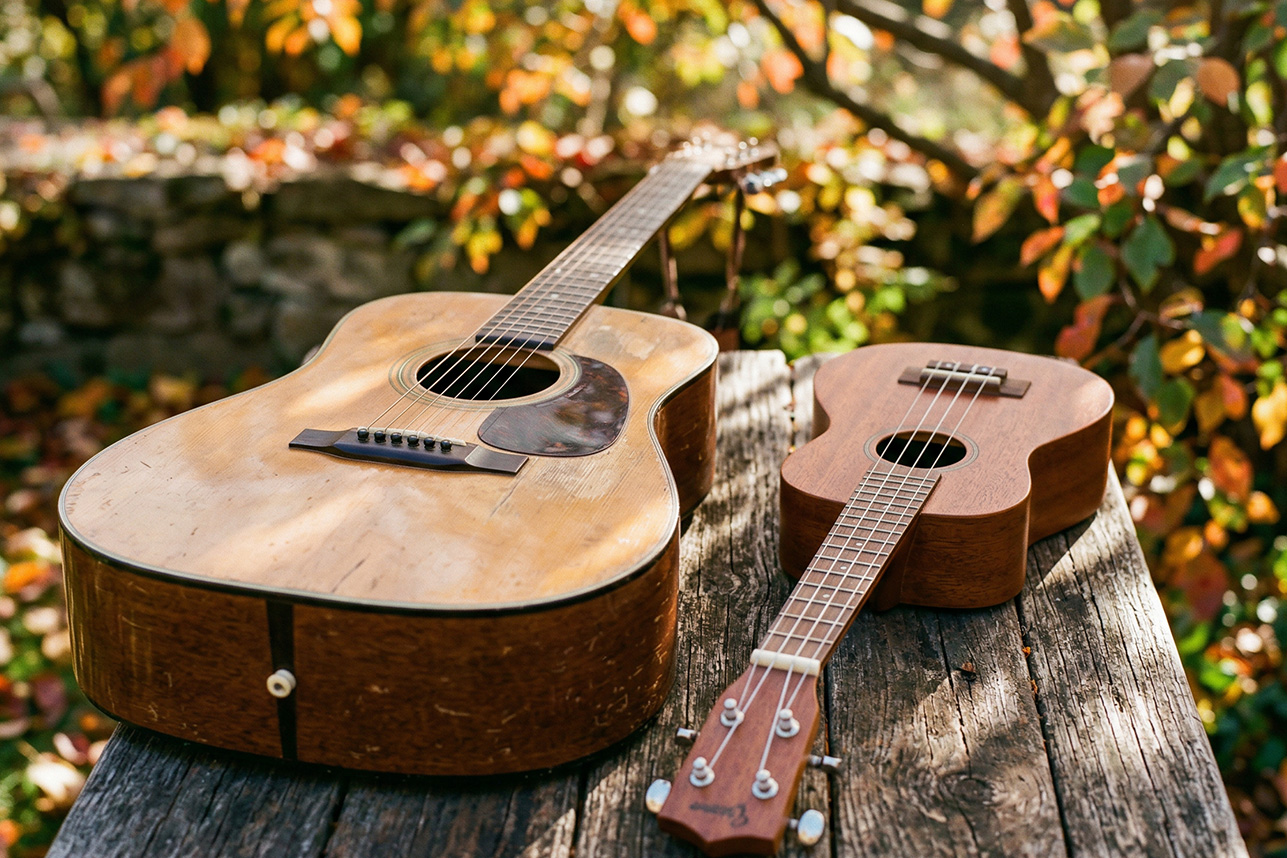
The physical difference between these two instruments is immediately noticeable. A standard acoustic guitar measures 96 to 104 cm in length and weighs around 2.2 to 2.7 kg. A soprano ukulele is just 53 cm long and weighs as little as 300 to 475 grams, as noted by Kala, one of the most widely stocked ukulele brands in Singapore.
For young children or anyone with smaller hands, that difference is significant. The ukulele's compact fretboard requires less finger stretch, making chord shapes more manageable from day one. The guitar, while perfectly learnable at any age, asks more of your hands in the early stages.
Both instruments are portable by nature, but the ukulele wins comfortably on convenience. It fits in a small bag, hangs on a wall hook, and slides under a bed. A guitar needs its own dedicated corner of the room.
Strings and Finger Comfort: An Honest Look
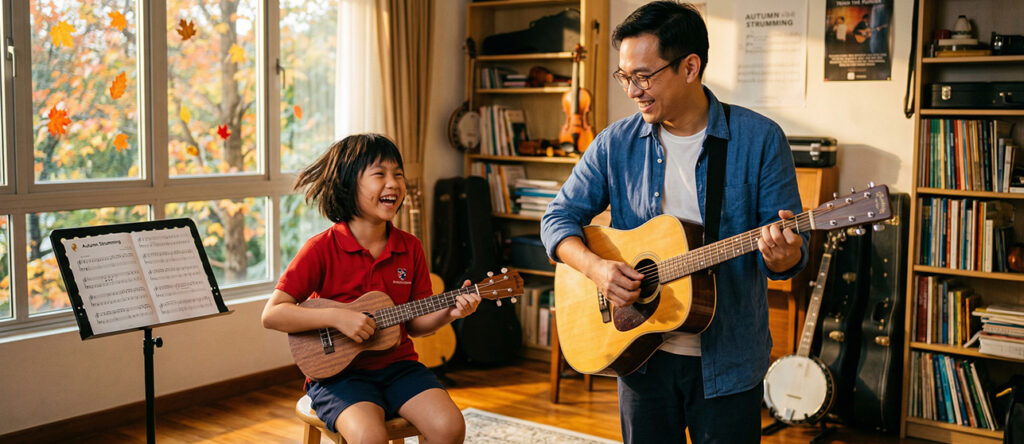
The guitar has six strings; the ukulele has four. That difference affects not just how you play, but how your fingers feel in those first few weeks.
Steel-string acoustic guitars require more finger pressure, and building up calluses typically takes two to four weeks of regular practice, as outlined by TrueFire. This soreness can be discouraging for younger beginners or those with limited practice time. Nylon-string classical guitars are softer on the fingers and serve as a gentler entry point if guitar is your goal.
Ukuleles use nylon or nylgut strings, which are low-tension and easy on fingertips from the very first session. Most beginners experience little to no soreness, which is one of the reasons young children and adults alike take to the instrument quickly.
Learning Curve: Which Instrument Gets You Playing Sooner?
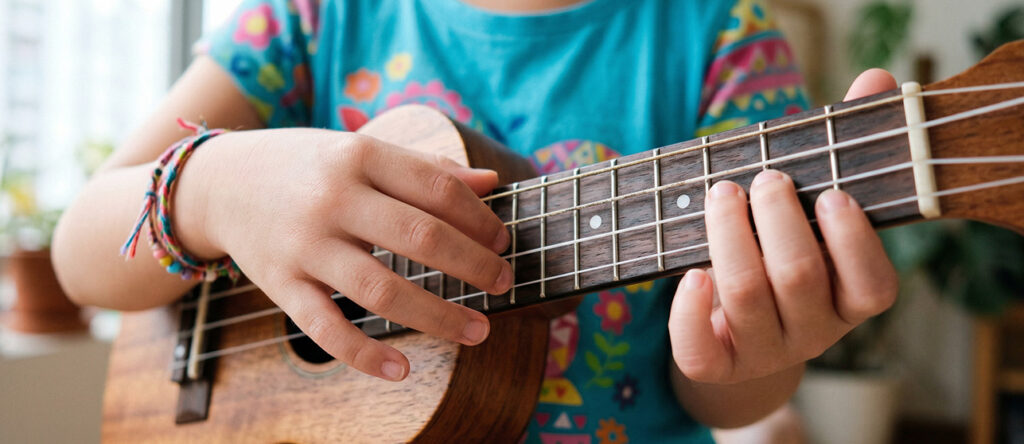
The ukulele has a noticeably gentler learning curve. With just four strings and simpler chord shapes, a complete beginner can play a recognisable song within days. Basic chords like C, G, Am, and F require only one or two fingers and unlock an enormous range of popular songs.
On guitar, the same basic chords require more fingers, wider stretches, and additional practice before transitions feel comfortable. Most beginners take two to six weeks to play through a simple song smoothly. That gap in early progress is one of the most common reasons beginners feel more immediately rewarded on ukulele, and why many music educators recommend it as a confidence-building starting point.
If your goal is guitar specifically, starting directly on guitar is still a valid path, and some music educators recommend it to avoid relearning chord shapes later. What transfers from ukulele to guitar includes rhythm, timing, strumming patterns, and basic music theory. What does not transfer are the specific chord fingerings, which differ between the two instruments.
Sound and Musical Range: What Each Instrument Can Do

The ukulele produces a bright, cheerful tone that suits pop, folk, Hawaiian music, and singer-songwriter styles particularly well. Its sound is warm and approachable, and well-matched to casual playing and social jamming.
The guitar offers a fuller, richer sound with a much broader tonal range, spanning roughly 3.5 to 4 octaves compared to the ukulele’s 2 octaves. It covers nearly every genre: pop, rock, blues, jazz, classical, folk, country, and more. If you have a specific musical style in mind, the guitar is more likely to fit it naturally.
For learners who are still exploring what they want to play, this is worth considering. The ukulele is a wonderful instrument in its own right, not simply a stepping stone to guitar. But if your musical goals point clearly toward versatility, the guitar’s range gives it a real advantage over time.
The HDB Reality: Noise and Space at Home
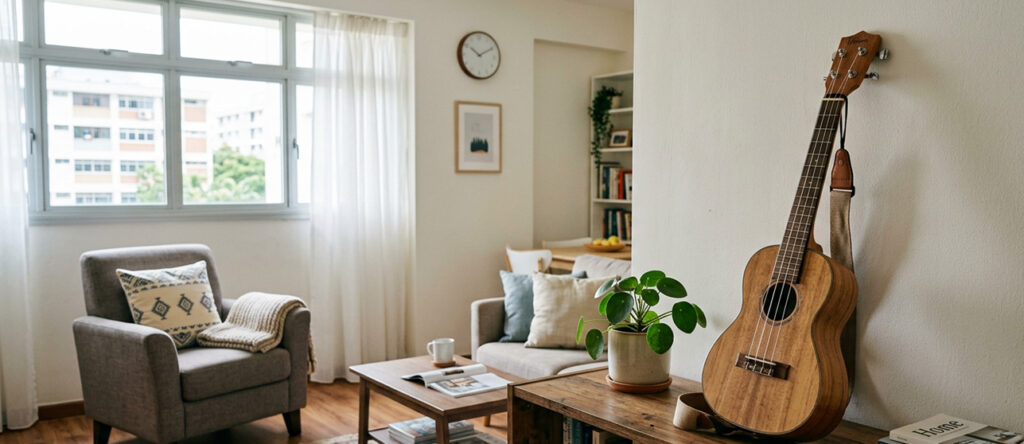
For the majority of Singaporeans living in HDB flats, noise and space are everyday considerations, and both factor into this decision.
On volume, the difference between the two instruments is small but meaningful. An acoustic guitar strumming forcefully registers at around 84 dB, while a ukulele sits at approximately 82 dB. More importantly, the guitar’s larger body projects more bass frequencies, which travel through shared walls and floors more readily than the ukulele’s higher-pitched output. Singapore’s quiet hours run from 10:30 PM to 7:00 AM, and the Community Advisory Panel on Neighbourhood Noise has recommended extending these hours further. Practising with a lighter touch or fingerpicking instead of strumming reduces volume noticeably on either instrument.
For those committed to guitar in an HDB setting, an unplugged electric guitar produces just 50 to 60 dB, close to normal conversation level, making it a practical and neighbour-friendly option especially paired with a headphone amp. Guitar Gear Finder provides a useful overview of headphone amp options for home practice.
Guitar vs Ukulele in Singapore: What Your Budget Gets You
The cost difference between starting on guitar versus ukulele is real, particularly for families buying a first instrument without knowing how long the interest will last.
Beginner Ukuleles in Singapore
|
Tier |
Example Models |
Price Range |
|---|---|---|
|
Budget |
Mahalo, Deviser entry models |
$39 to $69 |
|
Beginner sweet spot |
Kala KA-15S, Flight models |
$70 to $120 |
|
Concert size |
Kala Makala MK-C |
~$126 |
Beginner ukuleles are widely available at Swee Lee, Davis Guitar, and Ukulele Movement, Singapore’s dedicated ukulele specialist at Kitchener Complex. Strings cost around $3 to $15 per set and rarely need replacing more than once or twice a year.
Beginner Acoustic Guitars in Singapore
|
Tier |
Example Models |
Price Range |
|---|---|---|
|
Budget |
Generic and entry brands |
$59 to $149 |
|
Beginner sweet spot |
Yamaha F310, Cort AD810 |
$200 to $305 |
|
Children's sizes |
Yamaha CS40 (3/4 classical) |
~$185 |
The Yamaha F310 remains the most popular beginner acoustic in Singapore and is available as a bundle with a bag, strap, capo, and picks for around $260 to $280. Guitar strings run $5 to $22 per set, replaced roughly every two to three months with regular playing.
Who Each Instrument Suits Best
There is no single right answer, but a few patterns hold true across most beginners.
The ukulele tends to work best for children aged 4 to 7, anyone with small hands, learners who want early wins to stay motivated, and those practising in noise-sensitive environments. The instrument’s forgiving nature keeps early momentum strong, as noted by music educator Alice Bulmer.
The guitar is generally a better fit for teens and adults with a clear musical style in mind, and those who want long-term versatility. Children can begin guitar from around age 7 to 8, often starting on a 3/4 or 1/2 size instrument. At Groove Music School, our instructors work with students from as young as age 4 and can advise on the right starting point based on your child’s age, hand size, and goals.
Switching from ukulele to guitar later is common and manageable. Rhythm skills, musical confidence, and basic theory all carry forward, with the main adjustment being new chord shapes and six strings.
Try Both Before You Decide
Here is something most guides leave out: you do not need to own an instrument to start learning.
The most practical first step, especially if you are still weighing your options, is to begin guitar or ukulele lessons first. At Groove Music School, students play on quality instruments from their very first session, with no pressure to purchase anything upfront.
A few weeks of lessons will tell you far more than any amount of online research. You will quickly discover whether the guitar’s feel motivates you, whether the ukulele’s pace suits your learning style, and whether the commitment feels right before spending money on an instrument.
Groove’s instructors take a personalised approach to every student, tailoring lessons to your goals, pace, and musical interests, whether you are a child starting from age 4 or an adult picking up music for the first time. Lessons are designed with emotional and mental well-being in mind, so the process feels rewarding at every stage.
Once you and your teacher have a clear sense of where your interest lies, you will be in a much better position to choose the right instrument. Book a trial lesson at Groove Music School to get started.
Which Instrument Is Right for You?
|
Your Situation |
Recommended Choice |
|---|---|
|
Child aged 4 to 7 |
Ukulele |
|
Small hands or fingertip sensitivity |
Ukulele |
|
Living in an HDB flat |
Ukulele (or electric guitar with headphones) |
|
Budget under $150 |
Ukulele |
|
Interested in rock, blues, or jazz |
Guitar |
|
Want long-term musical versatility |
Guitar |
|
Teen or adult with a clear genre in mind |
Guitar |
|
Unsure where to start |
Try lessons first |
Ultimately, both instruments are capable of taking a complete beginner to a genuinely rewarding level of playing. The ukulele gets you there faster at the start; the guitar opens more doors over time. Neither choice is wrong, and switching instruments later is more common than you might think.
The most important step is not which instrument you choose. It is simply deciding to begin.