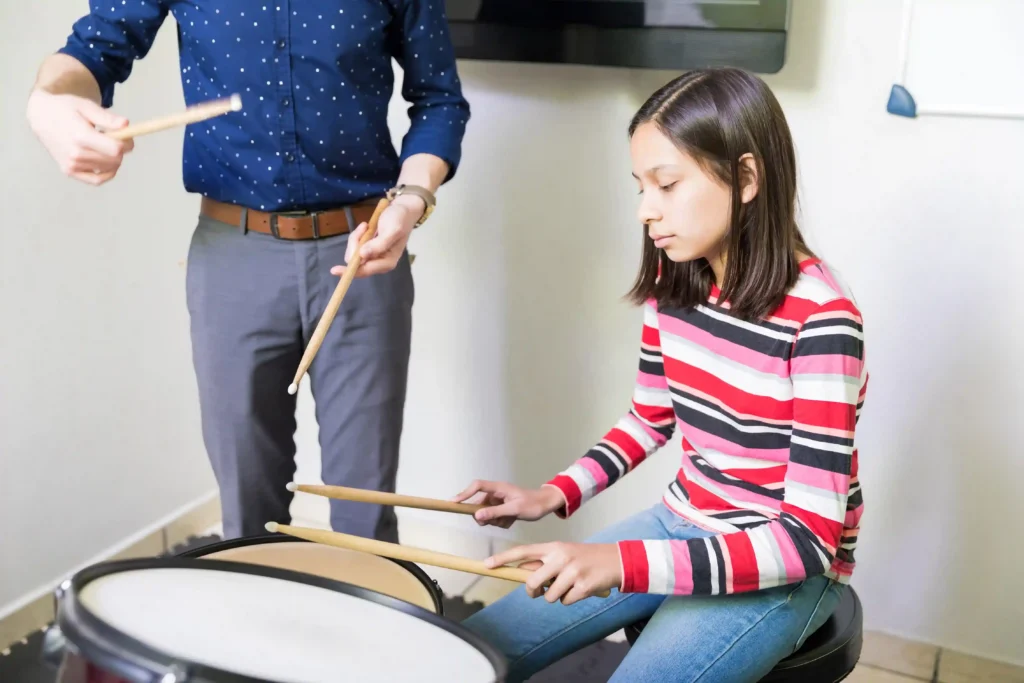
Here’s the truth about learning drums: they’re easy to start, but mastering them takes real commitment. You could be playing a recognisable beat by the end of your first lesson. Getting genuinely good though? That requires months of consistent practice and the right guidance.
Why Beginners Find Drums Surprisingly Easy to Pick Up

There’s something special about drums that other instruments just don’t have. Hit a drum, hear a sound. Simple as that. Compare this to wind instruments where you spend weeks trying to get a decent tone, or guitar where your fingers hurt before you can play a single chord properly.
The basic rock beat can be learned in a single session, often in just 30 minutes. You know that classic boom-tap-boom-tap rhythm you hear in countless songs? That’s it. Once you’ve got it down, you can play along to your favourite tracks straight away. And here’s the thing about drums: there aren’t really any “wrong notes”. As long as you’re keeping time, you can experiment and it won’t sound terrible.
Think about how babies instinctively bounce to music before they can even walk. Drumming taps into that same natural rhythm we all have. Rhythm is actually a fundamental aspect of human life; we experience it in our heartbeat and in the patterns of our daily activities. The physical aspect of drumming feels right in a way that reading sheet music often doesn’t for beginners.
When Things Start Getting Tricky

The real challenge kicks in when your brain has to coordinate four limbs doing completely different things at once. Our brains aren’t built for this naturally. Getting your left hand, right hand, left foot, and right foot all working independently whilst maintaining a steady rhythm? That’s what takes months of deliberate practice to develop muscle memory.
And let’s talk about timekeeping. As a drummer, you’re the foundation everyone else relies on. If your timing drifts even slightly, the whole band feels it. You can’t hide mistakes the way a guitarist or keyboardist sometimes can.
Then you’ve got advanced stuff like ghost notes (those subtle, quiet hits that add texture), polyrhythms, and odd time signatures. This is where having someone experienced really helps. They break down these seemingly impossible patterns into smaller pieces you can actually wrap your head around.
What Actually Determines How Fast You’ll Progress

Forget the myth about needing natural rhythm. Drum teachers will tell you the same thing: the students who practise consistently are the ones who get better fastest. Doesn’t matter if you think you’ve got no rhythm when you start. Passion beats talent every single time.
How you practise matters more than how long. Fifteen focused minutes every day will get you further than cramming three hours on Sunday. There’s actual research backing this up; regular practice literally changes how your brain processes coordination and rhythm. But here’s the catch: you need to practise the right things. Many beginners watch too many different YouTube tutorials and end up more confused than helped. Contradicting advice from multiple sources can actually slow your progress.
Good teaching prevents problems you don’t even know exist. Here’s a stat that should get your attention: research in Frontiers in Psychology showed drummers who learned proper technique from teachers had 50% fewer injuries. We’re talking carpal tunnel, tendinitis, back problems (stuff that can genuinely stop you playing altogether). Self-taught drummers often pick up bad habits without realising it, then spend years trying to fix them.
Age? Honestly doesn’t matter as much as you think. Adults actually bring advantages like better discipline, more patience, and genuine motivation. Your brain can form new neural pathways at any age. Don’t let anyone tell you otherwise.
What to Actually Expect: Real Timelines

Your first simple beat? Most people nail this somewhere between 30 minutes and a week. Within your first 1-3 months of regular practice, you’ll be playing along to straightforward songs without much trouble.
Give it 3-6 months and you’ll have basic grooves and fills sorted. By 6-12 months, you won’t feel like a beginner anymore. You’ll play confidently with music and start developing your own style.
Here’s some real data: a survey of over 130 drummers found most felt ready to gig after 26-35 months. But get this: 18% said they felt competent within just 12 months. The difference? Usually comes down to practice quality and instruction.
How the Right Teacher Changes Everything

Good instructors don’t just follow a textbook. They adapt to how you learn best and what actually interests you. At Groove Music School, drum lessons are customised to each student’s unique goals, whether you’re drawn to rock, jazz, or other styles. Nothing beats an in-person experience where a teacher can observe your technique in real time and make immediate corrections. This personalised approach keeps practice efficient and motivation high.
Getting technique right from day one saves so much frustration later. A qualified teacher spots and corrects issues with your grip, how hard you’re hitting, and your posture (things you’d never notice on your own until they’ve already caused problems).
The best teachers act more like mentors than instructors. They’re building your confidence alongside your skills, making the whole journey more enjoyable and less frustrating when you hit those inevitable rough patches.
Why Taking a Holistic Approach Actually Works

Effective drum instruction addresses more than just technical skills. At Groove Music School, lessons focus on improving emotional, mental, and physical well-being through music. This holistic approach develops not just drumming ability but also improved focus, discipline, and stress relief through creative expression.
They combine proper technique with understanding the mental side of drumming. You’re not just memorising patterns. You’re developing a real feel for rhythm that shows up in how you play. Science-based methods paired with emotional support helps you achieve what they call “musical freedom”.
Plus there’s the physical side. Drumming is a proper workout. Better coordination, improved stamina, endorphins like you’d get from exercise. It supports your overall well-being in ways that go beyond just learning an instrument.
Your Learning Environment Matters More Than You’d Think

Having access to professional equipment during lessons is huge. You don’t need to fork out thousands for a kit at home whilst you’re still figuring out if drumming’s your thing. Quality drums teach you proper touch and dynamics. Cheap ones? They can actually reinforce bad habits.
At Groove Music School, multiple instruments are available all in one place. Want to understand how drums fit with bass, guitar, piano, or vocals? You can explore that easily. This exposure makes you a more well-rounded musician.
The inclusive approach makes a real difference too. Whether you’re four years old or picking up sticks for the first time at sixty, the teaching methods adapt. Different ages need different approaches, and good instructors understand that.
Workshops, holiday camps, and group sessions accelerate learning in ways solo practice just can’t match. You’re playing with other musicians, learning from watching them, building communities with fellow students. Performance opportunities (even casual ones) build confidence that bedroom practice never will.
You’ve also got dedicated practice spaces, so no worrying about noise complaints or not having room for a kit. You experience how drums should actually sound when they’re properly tuned and set up.
The Reality: Drums Are Genuinely Learnable

Drums give you one of the best beginner experiences you’ll find. That moment in your first session when you play a recognisable beat? That feeling keeps you coming back.
Getting from beginner to competent takes time, but the survey data shows most students feel ready to play with others within 1-2 years of consistent practice. You see visible progress at every stage, which keeps motivation high. Remember that the journey is as important as the destination; enjoying the learning process is what makes you a proficient drummer in the long run.
The combination works brilliantly. Early wins give you confidence, whilst long-term depth means you’ll never run out of new things to explore.
Ready to Start Your Drumming Journey?
So can you learn drums? Absolutely, at any age. The key is finding instruction that actually adapts to your pace and goals rather than forcing you through a rigid programme.
At Groove Music School, experienced instructors combine personalised teaching with that holistic approach we mentioned. They’re developing your musical skills alongside your emotional and mental well-being. From your first beat through to advanced techniques, you get the support and structure you need to actually succeed.
Want to see if drumming’s right for you? Book a free trial lesson and experience what personalised instruction in a welcoming environment feels like. You’ll play your first beat in that very first session and walk out with a clear idea of where your drumming journey could go.